Why Do I Feel Anxious All the Time?
If you feel anxious all the time, it may be because your mind and body have become used to being on alert, looking for problems or trying to protect you from things that feel uncertain or unfamiliar.
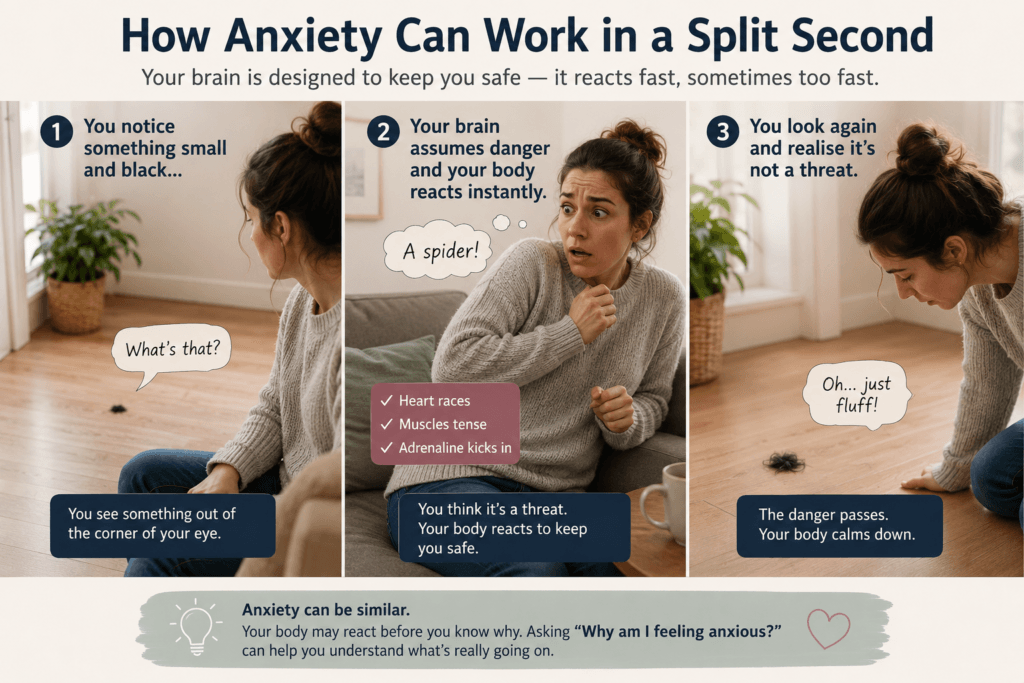
Think about seeing something small and black on the floor out of the corner of your eye. For a split second, you think it’s a spider, and your body reacts — only to look again and realise it’s just a piece of fluff.
Your brain was trying to protect you. It spotted something that might be a threat and reacted before it had all the information.
Anxiety can sometimes work in a similar way. Your mind may become very good at spotting possible problems — a change in someone’s tone of voice, something different happening at work, an unfamiliar situation or the possibility that something might go wrong.
The danger may not actually be there, but the anxious response can still feel very real.
One of the things I often explain to people who come to see me with anxiety is this:
Anxiety is often trying to protect you.
The problem is that sometimes it starts trying to protect you from things that aren’t actually dangerous.
Why can anxiety feel so overwhelming?
Imagine your anxious mind making all your decisions for you.
It might be perfectly happy to keep you at home, sitting safely on the couch.
Everything is familiar. Everything is predictable. There are fewer surprises and fewer opportunities for something to go wrong.
From anxiety’s point of view, that’s a pretty good arrangement.
But you probably don’t want to spend your life sitting safely on the couch.
You want to work, travel, meet people, take opportunities, try new things and get on with your life.
And that’s where anxiety can sometimes start getting in the way.
The goal isn’t always to wait until you feel absolutely no anxiety before doing something.
Sometimes it’s about gradually teaching yourself:
I’ve done this before. I can handle this. This is safe.
Over time, something that once felt frightening or unfamiliar can begin to feel much more normal.
“What if I’m not good enough?”
I recently worked with a young woman who was experiencing significant anxiety.
Things in her life were going well, and she had become comfortable and settled in her work.
Then something changed.
She was unexpectedly asked to move to a different working environment.
For someone else, this might have seemed like a relatively ordinary change.
For her, it triggered a flood of anxious thoughts.
Why are they moving me?
Was I not good enough where I was?
What if I don’t get on with the people there?
But when we looked more closely at what she actually knew, rather than what anxiety was telling her might happen, the picture was very different.
She already knew the people she would be working with.
She got on well with them.
There was no evidence that she wasn’t good enough.
The uncertainty around the change had created a space that anxiety quickly filled with “what ifs?”
Part of our work together involved helping her look at those thoughts differently. We questioned some of the assumptions she was making and explored other possible explanations rather than automatically accepting the most frightening interpretation.
Alongside this supportive work, I also used acupuncture as part of her individual treatment plan.
Anxiety can make unfamiliar things feel dangerous
This is something I see regularly.
The situation itself may not necessarily be dangerous, but it feels uncertain.
And uncertainty can give anxiety plenty to work with.
- A new job.
- A change at work.
- An exam.
- Going somewhere unfamiliar.
- Meeting new people.
- Doing something you haven’t done for a long time.
Anxiety may respond with:
- What if something goes wrong?
- What if I can’t cope?
- What if I fail?
- What if people judge me?
- What if I’m not good enough?
These thoughts can feel very convincing when you’re anxious.
But a thought isn’t necessarily a fact.
Sometimes one of the most useful things we can do is become curious about what anxiety is actually telling us.
- What am I afraid might happen?
- What evidence do I have that it will happen?
- What do I already know that might suggest a different outcome?
- What would make this situation feel more familiar and manageable?
When anxiety starts holding you back
Anxiety can sometimes create a difficult cycle.
Something makes you feel anxious, so you avoid it.
Avoiding it makes you feel safer in the short term.
But because you never get the opportunity to experience the situation differently, it can continue to feel frightening or overwhelming.
Your world can gradually become smaller.
That’s why I often talk to people about taking manageable steps towards the things they want to be able to do.
The aim isn’t necessarily to force yourself into situations that feel completely overwhelming.
It’s about asking:
What is the next manageable step?
Then, over time, something that once felt unfamiliar may begin to feel more familiar.
Something that felt impossible may begin to feel manageable.
And something anxiety once told you to avoid may gradually become part of normal life.
How I Can Help You With Anxiety
If anxiety is starting to make decisions for you — stopping you from doing things, making you constantly question yourself, or leaving you wondering why you feel the way you do — you don’t have to keep trying to work it out on your own.
When you come to see me, I want to understand your anxiety.
- What triggers it?
- What are you telling yourself when it happens?
- What are you avoiding because of it?
And perhaps most importantly:
What would you be doing differently if anxiety wasn’t making the decisions for you?
From there, we can look at the approach that feels right for you.
You don’t have to have acupuncture to work with me.
Some people choose acupuncture. Others prefer life coaching and NLP-based approaches, where we may work on recognising patterns, questioning anxious assumptions, reframing situations and finding practical ways to respond differently.
We may also explore how you personally experience your anxiety — the pictures or scenarios you create in your mind, the things you say to yourself internally, and the physical feelings you notice in your body. Understanding these different parts of your anxious response can help us identify patterns and explore ways of changing how you respond to them.
For some people, a combination of approaches works best.
If you’re tired of anxiety holding you back and you’d like to talk about what’s happening, give me a call on 087 227 3084.
I’m happy to chat, answer your questions, and talk through how I can support you.
Everyone’s experience of anxiety is different, and results vary. Persistent or severe anxiety can have many causes, so it’s important to seek appropriate support from your GP or a qualified mental-health professional when needed. The approaches I offer are intended to complement, not replace, appropriate medical or psychological care.
If anxiety keeps appearing, is getting worse or is beginning to affect your work, relationships, sleep or everyday life, it’s important to speak with your GP or an appropriate healthcare professional.
You may also find my article Why Do I Feel Anxious For No Reason? helpful. In it, I explain why anxiety can sometimes act like a protective response, constantly looking for potential problems or danger — even when you’re actually safe.
Read more: Why Do I Feel Anxious for No Reason? (coming soon)
Frequently Asked Questions
Why do I feel anxious when nothing is wrong?
Sometimes anxiety can occur even when there is no obvious immediate danger. Stress, uncertainty, previous experiences, habitual patterns of thinking and other physical or psychological factors may all play a role.
If anxiety is persistent, worsening or affecting your daily life, it’s worth discussing it with an appropriate healthcare professional.
Can anxiety make small problems feel much bigger?
When you’re already feeling anxious, uncertainty can sometimes lead to “what if?” thinking and worst-case scenarios.
Learning to recognise the difference between what you know and what you’re assuming may help you look at the situation from a different perspective.
Why do I avoid things that make me anxious?
Avoidance can provide short-term relief because you don’t have to face the uncomfortable situation.
However, repeatedly avoiding situations can sometimes reinforce the feeling that they are threatening. Appropriate support and gradual, manageable steps may help some people rebuild familiarity and confidence.
Can acupuncture help with anxiety?
Some people use acupuncture as part of their approach to managing stress and anxiety.
Responses vary from person to person, and acupuncture should not replace appropriate medical or mental-health care.
In my clinic, I use acupuncture alongside supportive conversations and practical approaches tailored to the individual.
When should I get professional help for anxiety?
If anxiety is persistent, significantly affecting your work, relationships, sleep or daily life, or you are struggling to cope, speak to your GP or a qualified mental-health professional.
If you feel you may be in immediate danger or at risk of harming yourself, seek urgent medical help.
Not sure whether acupuncture is the right choice for your anxiety?
Give me a call on 087 227 3084.
I’m happy to have a chat, answer your questions, and help you decide whether the approach I offer at Galway Acupuncture Hub in Loughrea might be suitable for you.
You can also book an appointment online.
A €20 booking deposit secures your appointment and is deducted from the cost of your treatment.
Appointments may also be eligible for reimbursement depending on your health insurance policy with VHI, Laya Healthcare or Irish Life Health.

About Lucy
I’m Lucy Townsley, an experienced anxiety and wellbeing practitioner based at Galway Acupuncture Hub in Loughrea, Co. Galway.
I’ve been working with people for over 25 years, supporting clients with concerns including anxiety, stress, sleep difficulties and pain.
My approach is about seeing the person behind the problem. I combine acupuncture with practical support and conversation to help people better understand what’s happening for them and find ways to move forward. Read more