Why Do I Keep Getting Headaches?
If you keep getting headaches, you may be wondering why they continue to return and whether you will ever get lasting relief.
Perhaps you wake up with pain already building.
Maybe the headache begins during the day and gradually becomes so heavy that you cannot think clearly, concentrate properly, or carry on as normal.
You may struggle through work, cancel plans, avoid bright lights or lie awake because your head feels as though it is going to burst.
In my clinical practice at Galway Acupuncture Hub in Loughrea, Co. Galway, I regularly consult with patients from across East Galway who are completely exhausted by this cycle. When this keeps happening, it is not “just a headache”.
It can affect your sleep, your mood, your energy, your relationships and your ability to enjoy everyday life.
There are many possible reasons why headaches recur. Stress, poor sleep, dehydration, missed meals, eyesight problems, hormonal changes, frequent painkiller use and tension around the neck and shoulders can all play a part.
But to understand your headache properly, we need to look at your individual pattern.
That includes exactly where the pain is, what it feels like, when it appears and what else is happening when it begins.
“Where Is Your Headache?”
This is one of the first questions I ask people who come to see me with headaches.
They often look at me strangely and say:
“It’s in my head.”
Of course it is—but I need to know exactly where in your head you feel it.
Is it on the left side or the right?
Is it across your forehead?
Is it at your temples?
Is it on the top of your head or concentrated at the back?
Does it begin in your neck and travel upwards?
Does it feel as though it starts behind your eyes?
Is it in one small area, or does your whole head feel painful, heavy, and full?
These details matter because not every headache follows the same pattern. The location alone does not tell us the cause, but it helps us understand more clearly what you are experiencing.
What Does Your Headache Feel Like?
I also need to know how you would describe the pain. Does it feel:
- Dull and constant?
- Heavy or pressurised?
- Tight or squeezing?
- Throbbing or pulsing?
- Sharp and piercing?
- Stabbing?
- Tender?
- As though pressure is building inside your head?
People sometimes think a dull headache is not as serious or difficult as a sharp one. But that is not true.
A dull headache that lasts for hours—or returns day after day—can be completely exhausting. You may still manage to go to work, look after your family and complete everything you need to do, but you are doing it all while carrying constant pain.
That can leave you mentally drained, irritable and unable to concentrate. A headache does not have to be sharp or dramatic to affect your quality of life.
Does Your Headache Begin in Your Neck?
If your headache is concentrated at the back of your head, I will usually ask about your neck and shoulders too. You may notice that:
- Your neck feels stiff or restricted
- Your shoulders constantly feel tense
- The pain begins at the base of your skull
- The headache travels upwards from your neck
- Looking down at your phone makes it worse
- Working at a computer triggers the pain
- Turning your head feels uncomfortable
- The headache is worse after driving or sitting for long periods
You may have assumed that the problem was entirely inside your head, without realising how much tension you are carrying through your neck, shoulders and upper back.
Sometimes people describe feeling as though they want to pull their head off their shoulders because the pressure between the neck and head is so intense. That description may sound extreme to someone who has never experienced it, but when headaches are severe or constant, that is genuinely how distressing they can feel.
If neck and shoulder tension is part of your headache pattern, you may also find my article on neck and shoulder pain helpful.
Is the Pain Behind Your Eyes?
Some people feel their headaches behind one or both eyes. You may experience:
- Pressure behind your eyes
- Aching around the eye sockets
- Sensitivity to light
- Difficulty looking at screens
- Blurred vision
- Watery eyes
- Pain across your forehead
- Pressure around your face or nose
You might assume this is caused by your sinuses, particularly if you also experience congestion or facial pressure. However, pain behind the eyes can occur with different headache patterns, so it is important not to make assumptions based only on where the pain is felt.
New visual changes, eye redness, or sudden severe eye pain should always be medically assessed.
Does Your Whole Head Feel Heavy?
Perhaps you cannot point to one exact area. Your whole head may feel:
- Heavy
- Tight
- Full
- Pressurised
- Foggy
- Tender
- As though it might burst
You may feel as though you are walking around in a haze. Simple tasks become harder. You lose your train of thought. You struggle to focus on conversations or remember what you were doing.
This brain fog can be almost as frustrating as the pain itself. You may worry that you are becoming forgetful or less capable, when the reality is that you are trying to function while your body is dealing with persistent discomfort and poor sleep.
What Else Happens With Your Headache?
Your headache may not be the only symptom. You may also experience:
- Nausea
- Dizziness
- Sensitivity to light or noise
- Visual disturbances
- Exhaustion or brain fog
- Neck stiffness or shoulder tension
- Facial pressure or nasal congestion
- Poor sleep or difficulty sleeping
- Mood changes
- Jaw tension or teeth grinding
You may find that movement makes the headache worse, or that you need to lie quietly in a dark room until it passes.
You may also feel anxious about the next headache. Even when you are not in pain, part of you may be waiting for it to return. That uncertainty can begin to control your decisions: Can I make plans? Will I manage work tomorrow? Will I be able to drive? Will the lights make it worse? Will the tablets work this time? Will I sleep tonight? When will it come back?
This is how recurring headaches can begin to affect much more than your head.
Why Do Your Headaches Keep Coming Back?
There may not be one single cause. Your headaches may be connected with several factors working together, including:
- Stress or anxiety
- Poor or irregular sleep
- Dehydration or skipping meals
- Eyesight or screen strain
- Neck and shoulder tension
- Posture
- Hormonal changes or menstrual cycles
- Perimenopause or menopause
- Jaw clenching or teeth grinding
- Alcohol or changes in caffeine intake
- Illness
- Frequent painkiller use
You may notice that your headaches are worse during stressful periods or after several nights of poor sleep. They may appear around a particular stage of your menstrual cycle. They may begin after hours at a computer, while long-distance driving, or by repeatedly looking down at your phone. Or you may feel that they happen without any obvious reason at all. This is why looking at the full pattern is so important.
Keep a Headache Diary
When headaches keep returning, it can be difficult to remember every detail. A simple headache diary may help you identify patterns. Record:
- When the headache started
- Where you felt the pain and what it felt like
- How severe it became and how long it lasted
- What you had eaten and drunk
- How you slept the night before
- Whether you were under unusual stress
- Where you were in your menstrual cycle
- Whether you had been working at a screen
- Any medication you took
- Any additional symptoms
- What made the headache better or worse
After a few weeks, you may begin to notice connections that were not obvious before. This information can also be useful when speaking with your GP or another healthcare professional.
When Should You Speak to Your GP?
Recurring headaches should not simply be ignored, particularly if they are becoming more frequent, changing in character or interfering with your daily life. Arrange a medical assessment if:
- The pain is becoming worse
- Your usual medication is no longer helping
- The pattern has changed
- The headaches are affecting work, sleep or normal activities
- You are worried about the symptoms
Seek urgent medical care if you experience:
- A sudden, extremely severe headache
- Weakness or numbness
- Difficulty speaking or confusion
- Loss of consciousness or a seizure
- Loss of vision
- A high temperature with a stiff neck
- A headache following a significant head injury
- Persistent vomiting
- New or severe eye symptoms
These symptoms need urgent medical assessment rather than complementary treatment.
How I Approach Recurring Headaches
When you come to see me, I do not simply hear the word “headache” and give everyone the same treatment. I want to understand your headache. I will ask:
- Where exactly do you feel the pain?
- What does it feel like?
- How often does it happen?
- How long does it last?
- Does it begin in your neck?
- Are your shoulders constantly tense?
- Does it happen around your menstrual cycle?
- Are you sleeping properly?
- Are stress or anxiety affecting you?
- Do you experience nausea, dizziness or visual symptoms?
- How much is the headache interfering with your life?
These questions help me understand you as a whole person rather than treating the headache as an isolated symptom. Your experience may be completely different from the experience of the next person who walks through the clinic door. That is why your treatment approach needs to be individual too.
Can Acupuncture Help With Headaches?
Acupuncture is one option that some people consider as part of managing recurring headaches, including tension-type headaches and migraine. Treatment is tailored according to your individual symptoms, headache pattern, general health and the factors that may be contributing to the problem.
The aim is not to make unrealistic promises or suggest that every headache can be treated in the same way. Some people report improvements in the frequency or intensity of their headaches, while results vary from person to person.
Acupuncture can support—but should not replace—appropriate medical care. If your headaches are new, severe, worsening or accompanied by unusual symptoms, you should speak with your GP before considering complementary treatment.
Not Sure Whether Acupuncture Is Right for Your Headaches?
Perhaps you have been putting up with headaches for so long that you have started to accept them as part of your life. But if the pain is affecting your sleep, concentration, mood, work or ability to enjoy your day, it is worth asking for support.
Give me a call on 087 227 3084. You can tell me what has been happening, ask any questions, and have a chat before deciding whether you would like to book an appointment.
You can also book online via our direct calendar link:
Click here to secure your appointment online.
Note: A €20 booking deposit is required. This is deducted from the cost of your appointment and can be transferred or refunded when at least 24 hours’ notice is provided. Depending on your policy, you may be able to claim back part of the cost of acupuncture through VHI, Laya Healthcare or Irish Life Health. Check your individual policy for details.
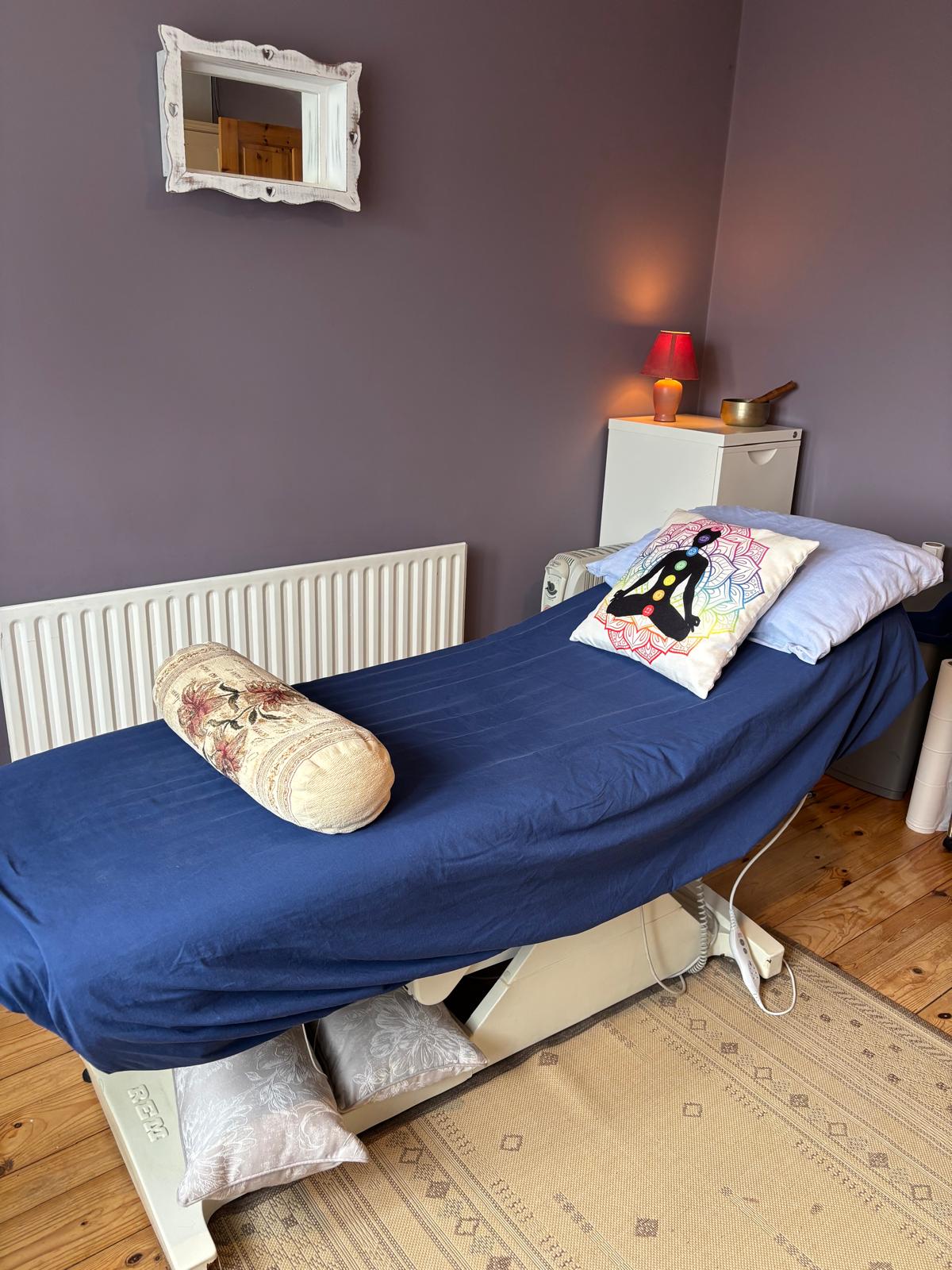
Our clinic room is easily accessible for local residents in Loughrea town and those travelling in for pain relief from surrounding communities including Craughwell, Athenry, Gort, Oranmore, and Portumna.

About Lucy Townsley
I am Lucy Townsley, an experienced acupuncturist based at Galway Acupuncture Hub – Pain Relief Clinic in Loughrea, County Galway. For more than 25 years, I have supported people experiencing headaches, pain, poor sleep, stress, anxiety, hormonal changes and other health concerns.
My approach is practical, supportive and individual. I take time to listen to what you are experiencing, understand how it is affecting your life and create a treatment approach based on your particular needs. Read More
FAQs: Why does my neck stiffness always trigger a headache behind my eyes? 🧠⚡
Q: Can tight shoulder and neck muscles actually cause a headache behind my eyes?
A: Yes, absolutely! This is one of the most common issues I treat in Loughrea. The suboccipital muscles at the base of your skull are highly sensitive. When they tighten from stress, computer work, or driving, they compress local nerves. This triggers a pain signal that travels over the top of your head and settles directly behind your eye sockets.
Q: I am tired of relying on painkillers. Can acupuncture offer a long-term fix?
A: Yes. Instead of just masking the symptoms, gentle acupuncture works deeply to relax specific muscle knots, improve blood circulation to the head, and reset your overactive nervous system to naturally break the recurring pain cycle.
Q: How far do people travel to your clinic for headache treatment?
A: While my clinic room is based in Loughrea town, I regularly welcome patients who make the short drive in for specialized pain relief from surrounding communities like Craughwell, Athenry, Gort, Oranmore, and Portumna.
Stop living with daily head pain and foggy concentration. Click below to view our treatment options and secure your consultation at Galway Acupuncture Hub – Pain Relief Clinic!
Please note: This article is intended for general educational purposes and should not replace advice from your GP or another qualified healthcare professional. Seek medical assessment for headaches that are new, severe, worsening, recurring, or accompanied by unusual symptoms. A sudden extreme headache, neurological symptoms, loss of vision, seizure, confusion, fever with a stiff neck, or a headache following a significant head injury requires urgent medical attention.